What is Tsugaru kogin-zashi?
A traditional farmer’s work coat from northern Japan carries an unexpected physical weight. Held in the hands, the garment does not drape or fold easily over the arm. It is stiff, heavy, and unusually thick, feeling more like a piece of flexible armour than a standard shirt. The base material is loosely woven hemp, which in its natural state weighs very little and offers no resistance to the wind. The mass of the garment comes entirely from the hundreds of thousands of dense, horizontal white cotton stitches packed tightly into the grid of the cloth.
This specific textile tradition is known as kogin-zashi (こぎん刺し). The terminology translates simply and practically: kogin historically referred to the short, narrow-sleeved work jackets worn by local farmers, and zashi means stitches. It is a highly specific, rule-bound form of counted-thread embroidery native to the Tsugaru region of Aomori Prefecture, located at the extreme northern end of Japan’s main island of Honshu.
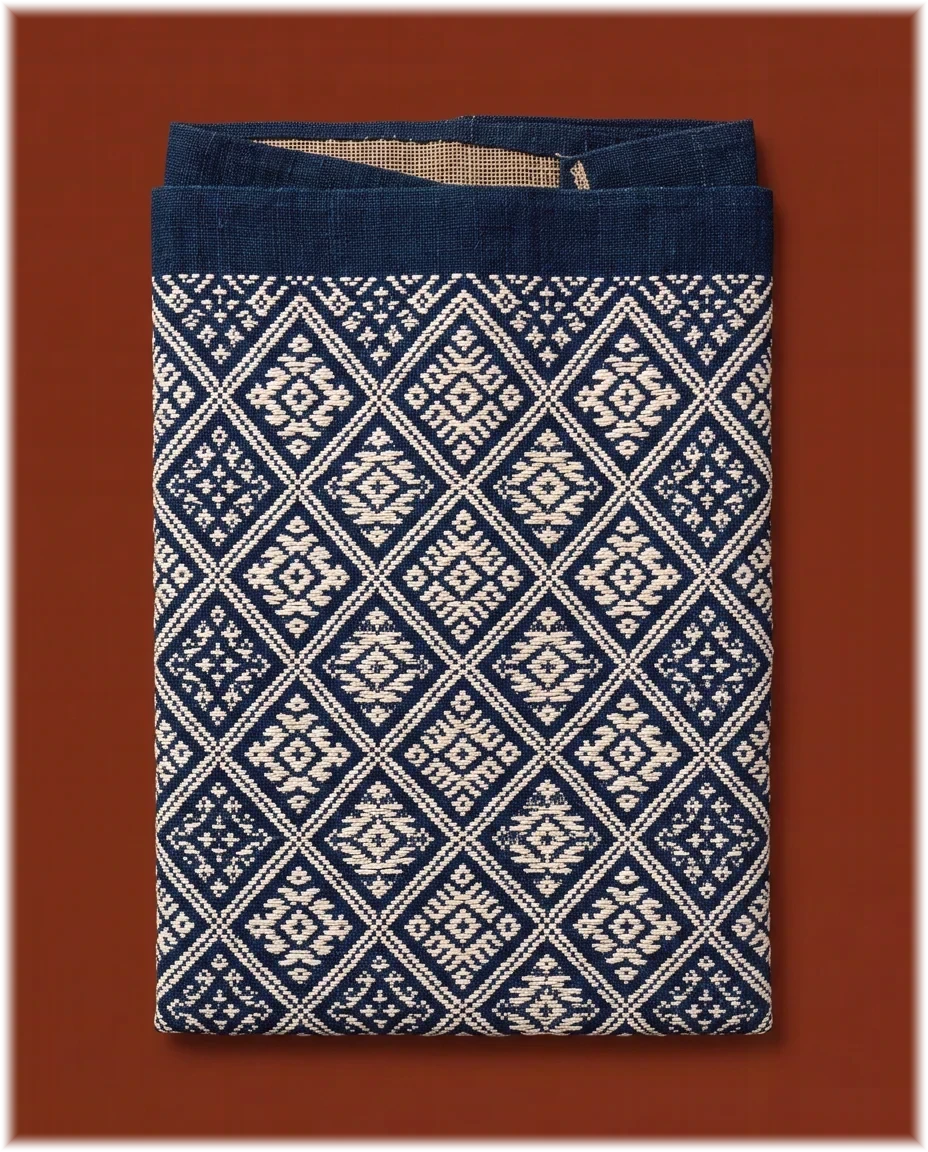
To look at historical examples of this work is to see a strict exercise in mathematics. The bright white thread forms sharp, symmetrical diamond patterns that repeat endlessly across the shoulders, the chest, and the back of the garments. There are no flowing curves, no loose threads, and no freehand floral motifs scattered across the fabric. Every shape, every angle, and every line is dictated absolutely by the rigid intersection of the vertical warp and the horizontal weft.
Today, the bold geometric contrast of stark white on deep indigo is studied globally as a peak of rural textile design. Collectors prize the surviving garments for their striking, modern-looking aesthetics. But the women who originated and perfected the technique in the late eighteenth century were not concerned with creating art. They stitched with relentless precision because the alternative was freezing to death in the snow.
Why did farmers embroider hemp work coats?

The origins of the craft lie entirely in the strict social controls and economic realities of the Edo period. For over two centuries, the ruling Tokugawa shogunate enforced comprehensive sumptuary laws that dictated exactly what each class of society was permitted to wear, own, and consume. For the rural farming class of the Tsugaru domain, the laws were economically paralyzing. Farmers were explicitly forbidden from wearing expensive, comfortable materials like silk or imported cotton.
Instead, the rural population was legally restricted to wearing cloth made from materials they could cultivate themselves in the rocky soil, or forage directly from the surrounding mountains. In Aomori, the primary textile crop was hemp. The plant grew fast during the short northern summers and yielded strong, long fibers that women spun and wove into cloth on heavy wooden household looms. Hemp is highly durable and highly breathable, which makes it an excellent, cooling material for the oppressive humidity of a Japanese summer.
However, Aomori winters are defined by deep, persistent snow and punishing ground blizzards sweeping in directly from the Sea of Japan. Hemp fiber naturally conducts heat away from the body. When woven on a rudimentary hand loom, the resulting cloth is full of small gaps between the warp and weft threads. Wearing a single layer of unlined hemp in a northern blizzard offered almost zero protection from the sub-zero wind.
Cotton thread, however, could still be had in small amounts. The women of Tsugaru began stitching it into the hemp work clothes their families wore, to reinforce the cloth and to keep out the cold. Cotton thread was far thicker than the hemp it was sewn into, and the dense rows of stitching trapped insulating pockets of air.
Women began systematically threading coarse white cotton through the open weave of their indigo-dyed hemp jackets. By packing the empty gaps in the grid with thick yarn, they transformed a flat, porous summer fabric into a dense, heavily insulated, windproof material. They concentrated the heaviest, thickest stitching on the shoulders, the chest, and the lower back—the areas of the body most exposed to the biting cold and most subjected to the tearing friction of carrying heavy agricultural baskets.
The foundational, unbreakable rule of kogin-zashi is that the needle must pass over an odd number of warp threads—typically one, three, five, or seven.
How are kogin-zashi patterns stitched?
While kogin-zashi is often grouped under the broader national category of sashiko (刺し子), its execution is entirely different from the stitching found further south. Standard sashiko allows the maker to draw circles, crashing waves, and intersecting diagonal lines freely across the surface of the fabric, treating the cloth as a blank canvas. Kogin-zashi, by contrast, is strictly bound by the existing architecture of the cloth.
The technique is technically a form of pattern darning. The needle only ever moves in perfectly straight horizontal lines, following the path of the weft of the fabric. To create the pattern, the stitcher counts the vertical warp threads by eye. The foundational, unbreakable rule of kogin-zashi is that the needle must pass over an odd number of warp threads—typically one, three, five, or seven. The thread never passes over an even number.
This strict mathematical constraint naturally generates stepped diamonds rather than flat squares or straight rectangles. As the horizontal rows stack tightly on top of each other, the widening and narrowing of the odd-numbered thread counts form precise, stepped geometric shapes. The basic unit of these patterns is called a modoko (モドコ), which serves as the building block for the entire garment.
There are approximately forty traditional modoko recorded in the Tsugaru region. Their names serve as a direct documentary record of the immediate physical world of the northern farmer. Patterns are named after walnut shells, bamboo joints, stone steps, cat’s eyes, and the metal bits used on packhorses. A single work coat might feature a massive central modoko bordered by dozens of smaller, repeating motifs that stretch seamlessly from the collar to the side seams.
The physical act of executing these patterns required specialized, localized tools. Because the hemp cloth was kept under high tension during the work, the needle had to be exceptionally long to push through an entire pattern block at a single time. To drive the heavy steel needle through the stiff, resistant hemp, the maker wore a flat, metal plate resting on the inside base of the middle finger. This tool allowed the stitcher to drive the needle forcefully from the palm rather than relying on the weaker fingertip.

Why is kogin-zashi stitched with white thread on indigo cloth?
The stark visual contrast of traditional kogin-zashi—bright white thread laid over dark blue cloth—was a direct product of practical rural chemistry. The raw hemp cloth was repeatedly dyed in deep vats of fermented indigo. Indigo dye contains specific compounds that naturally repel insects, resist rotting, and physically strengthen the cellulose fibers of the cloth. The cotton thread, which was difficult and expensive to acquire, was simply left in its natural, unbleached state to save money and time.
Within the isolated farming communities, the brightness of the white thread functioned as a clear social marker. Young girls began learning to count threads and stitch basic modoko around the age of five or seven. During the long, dark winter months when deep snow made outdoor fieldwork impossible, they practiced their stitching for hours by the fire, eventually making heavily embroidered jackets for their future husbands and themselves to wear.
Fresh, bright white patterns were an accepted symbol of youth, vitality, and readiness for marriage. A heavily and flawlessly stitched jacket was a public demonstration of a young woman’s immense patience, physical endurance, and domestic capability. But as a woman aged into her thirties and forties, wearing stark white embroidery was considered socially inappropriate, as it drew too much attention to the wearer.
Older women, however, still desperately needed the physical warmth and wind protection provided by the densely stitched garments. Instead of discarding the coats or picking out the threads, they simply dyed the entire garment again. The heavy jacket was submerged whole into the indigo vat. The white cotton threads absorbed the blue dye, muting the loud, aggressive geometric patterns into a dark, subtle texture that blended quietly into the background of village life.
These garments were used continuously until they physically disintegrated. When the cuffs frayed beyond repair or the shoulders finally wore completely through, the coat was dismantled. The surviving, intact sections of heavy embroidery were cut out, rotated, and stitched into other garments, or used as heavy rags for handling hot iron pots. A single jacket might be worn, patched, and redistributed across three generations before the fabric finally gave way.
What are the three regional styles of kogin-zashi?
The Tsugaru domain was not a uniform, flat landscape. Micro-variations in local climate, soil fertility, and proximity to regional trade routes created highly distinct economic realities within the valleys. As a direct result of these local conditions, the embroidery organically developed into three recognized regional styles, each visibly shaped by the specific hardships of its geography.
| Style Name | Region | Identifying Characteristics |
|---|---|---|
| Nishi-kogin | West of Hirosaki, along the Iwaki River | The most intricate and dense stitching. Often features horizontal stripes on the shoulders made with alternating black and white threads. |
| Higashi-kogin | East of Hirosaki, centered around Kuroishi | Coarser base cloth and thicker thread. Patterns are bolder, simpler, and heavily focused on practical reinforcement over display. |
| Mishima-kogin | Kita-Tsugaru, centred on the town of Kanagi on the lower Iwaki River | Named for its three sets of three horizontal stripes across the front and back near the shoulders, with bold diagonal patterns between them. The rarest of the three. |
Nishi-kogin, originating in the slightly more fertile and prosperous agricultural areas west of Hirosaki, exhibits the most sophisticated and tightly packed geometry. Women in this district had marginally more access to imported cotton thread and slightly more winter downtime to stitch. They developed the highly specific practice of alternating black and white threads across the shoulders, creating a thick, padded horizontal stripe that cushioned the immense weight of heavy burdens carried on the back.
In stark contrast, Higashi-kogin from the eastern Kuroishi area relied on much heavier, rougher materials. The local hemp grown in the east was spun thicker, and the cotton yarn acquired there was coarser. The resulting garments entirely lack the delicate, obsessive precision of the western style, but they project a rugged, undeniable physical durability. The modoko here are drafted larger and are less varied, prioritizing rapid completion and immediate warmth over complex display.
Mishima-kogin comes from Kita-Tsugaru, the district around the town of Kanagi on the lower reaches of the Iwaki River. Its name means “three stripes”: on both the front and the back of the garment, three sets of three horizontal stripes run across the area near the shoulders, and the patterns between them lean on bold diagonal lines known as nagare. Very few pieces survive, and it is the rarest of the three styles.
In December 1894 the railway reached Hirosaki from Aomori, tying Tsugaru into the national network. Over the following decades, cheap machine-woven cotton cloth became easy to buy in the north. The old sumptuary laws had already been abolished, and the absolute, life-or-death necessity of stitching hemp to survive the winter evaporated. Yet the visual logic of the modoko had already rooted itself deeply in the culture of Aomori. The original problem disappeared, but the strict geometry remained, preserving the memory of the cold in every counted thread.
Maison Homura is a small museum of Japanese objects in Fukuoka — folk toys, ceramics, carved wood and Takaoka bronze, each catalogued with where it was made, how, and what it was for.