What is koginzashi embroidery?
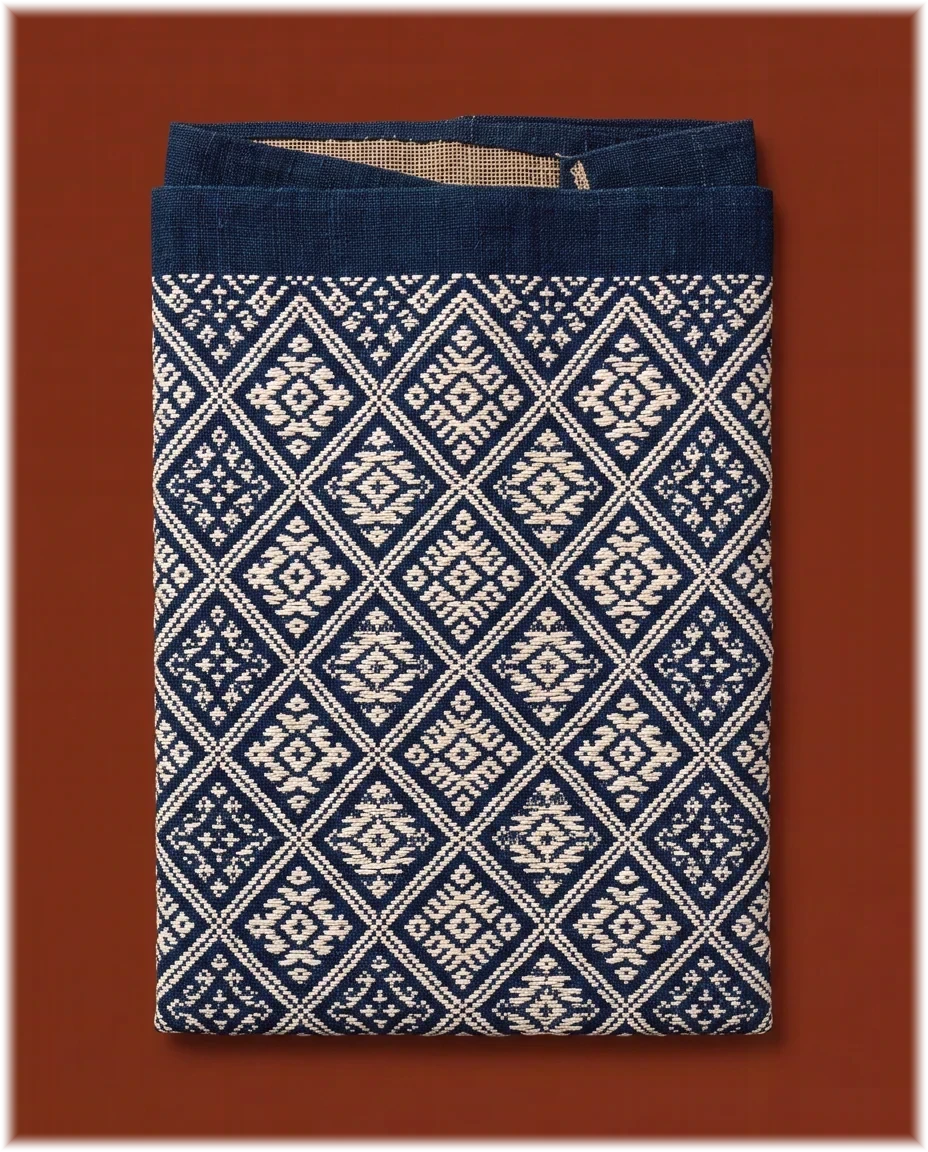
Turn a heavy agricultural jacket inside out. The interior reveals a dense architecture of white cotton thread laid over dark blue fabric. The textile carries significant physical weight. The threads run strictly in straight horizontal lines, wrapping the base material in a thick, insulating layer. The fabric resists bending. This is koginzashi [こぎん刺し]. It is a highly specific form of counted-thread embroidery developed by farmers in the Tsugaru region of Aomori Prefecture during the Edo period [江戸時代].
The technique is often confused with sashiko [刺し子]. The two methods share a common historical purpose but employ entirely different mechanical rules. Sashiko utilizes running stitches that can move freely in any direction, forming rolling curves and intersecting diagonal grids across the cloth. Koginzashi is strictly linear and bound by the weave. The needle only travels back and forth along the weft of the fabric. The stitcher must constantly count the vertical warp threads and pass the cotton over them in precise mathematical increments, building patterns row by row.
This rigid method was born from legal and climatic restrictions. Winters in northern Honshu are exceptionally harsh. Yet sumptuary laws imposed by the ruling classes strictly forbade rural farmers from wearing cotton, dictating that their everyday garments be made from locally grown bast fibers like hemp and ramie. These materials, known collectively as asa [麻], wear exceedingly well under agricultural labor but provide almost no insulation against the cold.
To survive without violating the law, the rural population found a loophole. While woven cotton cloth was banned, thick cotton thread was not explicitly forbidden. Women began weaving highly porous hemp cloth and reinforcing it by darning thick, unbleached cotton threads through the gaps. They packed the horizontal stitches so densely that the resulting fabric became a heavy, nearly windproof shield. Over generations, this simple structural reinforcement evolved into a catalog of distinct geometric motifs known as modoko [モドコ]. These basic units combine to form complex, repeating diamond grids across the shoulders and chest of a garment.
What are the regional styles of koginzashi?

The patterns of traditional koginzashi serve as a precise geographical record of the Tsugaru region. By the late nineteenth century, the embroidery had fractured into three distinct regional styles. The primary dividing line was the Iwaki River, which cuts directly through the agricultural plains of Aomori. A collector examining an unmarked vintage jacket today can usually determine its exact origin simply by mapping the layout of the stitches on the chest.
West of the river, in the areas surrounding Hirosaki city, weavers produced Nishi-kogin [西こぎん]. The hemp cultivated in this western area was relatively fine, allowing for a tight base weave. This finer canvas permitted small, highly complex, and densely packed needlework. Nishi pieces are immediately identifiable by this intricate patterning covering the chest, sharply bordered by distinct horizontal stripes running across the shoulders. These stripes were purely practical, placing extra thread exactly where a heavy carrying pole would rub against the collarbone.
East of the river lay the domain of Higashi-kogin [東こぎん]. The soil here yielded coarser, thicker hemp plants. The base fabric woven from these plants was consequently looser and rougher. Because the warp threads were thicker, the embroidery required longer, bolder stitches. Higashi garments completely lack the horizontal shoulder stripes found in the west. Instead, they feature massive, uninterrupted diamond patterns that stretch boldly across the entire front panel of the work coat, creating a striking graphic contrast against the dark indigo background.
Further north, in the river delta where the Iwaki meets the sea, the agricultural yield was frequently poor. This challenging area produced Mishima-kogin [三縞こぎん]. Life in the delta involved repeated periods of flood and famine, and the textiles accurately reflect a much harsher existence. The needlework is sometimes uneven or irregular. A Mishima garment is distinguished by three broad horizontal bands of embroidery separated by areas of plain cloth. This specific layout was designed to conserve precious cotton thread while still providing a thick layer of protection over the wearer’s vital organs.
| Lineage | Geographic Origin | Base Fabric | Key Visual Identifiers |
|---|---|---|---|
| Nishi-kogin | West of the Iwaki River | Fine, tightly woven hemp | Dense, intricate patterns; horizontal stripes at the shoulders |
| Higashi-kogin | East of the Iwaki River | Coarse, loosely woven hemp | Bold, oversized diamond motifs; no shoulder stripes |
| Mishima-kogin | Northern river delta | Variable hemp | Three distinct horizontal bands of patterns; irregular stitching |
The needle only travels back and forth along the weft of the fabric.
How can you tell vintage koginzashi from reproductions?
Koginzashi experienced a major commercial revival in the mid-twentieth century. Distinguishing a historical nineteenth-century agricultural garment from a mid-century reproduction requires checking the physical structure of the work. The first test is the base fabric. Modern commercial kogin cloth is uniformly machine-woven, featuring perfectly square intersections dyed a flat, consistent navy blue. Authentic antique garments are constructed from hand-loomed hemp. The tension is palpably uneven. Threads vary in thickness, and the indigo shows significant depth, fading unevenly where the fabric folded.
The second test involves the sheer density of the thread. Historical koginzashi was a critical survival mechanism, not a leisure craft. The goal was to cover the thin, porous hemp with as much thick cotton as structurally possible. In a genuine Edo or early Meiji period piece, the white embroidery almost entirely obscures the indigo base. Very little plain blue cloth is left exposed on the main panels. Modern interpretations treat the stitching purely as graphic decoration. They often isolate a single large diamond motif in the center of a panel, leaving vast, empty margins of plain blue fabric around it to highlight the design.
The third test is the strict mathematical rule of the floats. Traditional stitches only cross an odd number of warp threads. The needle floats over one, three, or a maximum of five warps before diving back into the cloth. A float of seven or nine threads would hang entirely too loose. It would inevitably snag on a stray branch or a wooden tool handle, destroying hours of labor. Consequently, historical weavers never crossed more than five warps at a time. Modern pieces, stitched for safe indoor display rather than rough field labor, frequently break this rule, featuring long, fragile floats of thread.
The fourth test lies in the color and twist of the thread itself. Before the advent of chemical bleaching, the cotton thread used in northern Japan retained its natural, unbleached color. Vintage pieces exhibit an off-white, slightly creamy hue that softens the stark contrast against the dark blue hemp. The thread is loosely twisted, allowing it to flatten out and cover more of the base fabric. Modern reproductions overwhelmingly utilize optic white, heavily mercerized cotton threads or synthetic blends. These modern threads sit high and tight on the fabric, creating a rigid, highly defined geometry that lacks the flattened integration of an authentic antique.

How should you store antique hemp and indigo textiles?
Acquiring a historical textile means taking custody of a fragile material system. The combination of dry, century-old hemp and natural indigo dye requires specific, careful handling. Over decades, hemp loses its internal moisture and becomes exceptionally brittle. Folding a dry hemp jacket sharply along the same crease will eventually snap the microscopic fibers in half, resulting in permanent tears along the fold lines. Handling should be kept to an absolute minimum, and the fabric should always be supported from underneath when lifted.
Natural indigo is a vat dye. Unlike chemical dyes that penetrate the fibers and bond with the core of the thread, natural indigo bonds mechanically to the rough surface. It builds up in microscopic external layers through repeated dipping and oxidizing. When the fabric moves and creates friction, these outer layers rub off. This phenomenon is called crocking. A vintage piece will continue to shed blue pigment onto hands, walls, and lighter fabrics simply through everyday physical contact. This is the intended physical behavior of the natural dye.
Storage methods must deliberately account for these material quirks. Never keep an indigo-dyed textile in a sealed plastic box or a synthetic garment bag. Plastic traps ambient humidity, which can quickly encourage mold growth deep inside the thick cotton embroidery threads. Furthermore, plastic off-gasses chemicals that can permanently alter the tone of the indigo dye. Instead, store the garment laying perfectly flat in a breathable, unbleached cotton bag. If the object must be folded due to space constraints, pad the folds heavily with acid-free archival tissue paper to prevent sharp creases from forming.
Light is the primary, unavoidable enemy of both materials. Ultraviolet radiation severely degrades the tensile strength of antique hemp, accelerating its transition into a brittle state. It also acts as a relentless bleaching agent on natural indigo, fading the rich, layered blues to a dull, flat grey. A historical piece should ideally be kept in a dark drawer or an archival box. If the textile is displayed on a wall or a rack in a room, it must be positioned completely out of the path of direct sunlight, and the room’s ambient light levels should be kept low.
How do you clean historical textiles?
The standard rule for cleaning historical textiles is to avoid it entirely. The mechanical action of washing rapidly accelerates the degradation of old fibers. Every wash removes a fraction of the original material. For most antique objects, a gentle airing out in a shaded, well-ventilated space is the only maintenance required. Dust can be carefully lifted from the surface using a soft brush, brushing lightly in the direction of the cotton threads.
If a piece has suffered an active, damaging spill or contains corrosive dirt that threatens the fabric, it must be washed with extreme caution. The water used must be strictly cold. Hot water causes the dry hemp fibers to swell rapidly and forces the indigo pigment to release its mechanical bond, resulting in sudden color loss. The soap must be completely pH-neutral. Common household laundry detergents are highly alkaline. Alkalinity strips natural indigo from the fabric instantly, permanently ruining the deep, layered variations of the dye.
There must be no agitation during the cleaning process. Do not put an antique hemp garment in a modern washing machine, even on the gentlest delicate cycle. The friction of the rotating drum will shift the heavy cotton threads and snap the brittle base fibers underneath. Instead, submerge the textile flat in a large, clean basin of cold water. Press the fabric gently with flat hands to push the water through the weave. Do not scrub the surface, and never twist or wring the fabric to dry it.
To dry the textile, lift it completely supported from underneath, as wet hemp cannot support its own weight. Lay it flat on clean, white cotton towels. Roll the towels up gently to press out the excess water without bending the fibers sharply. Unroll it immediately and transfer the piece to a dry surface in a cool, shaded room. The object remains heavy until the last of the moisture leaves the thick white threads, pinning the dark blue cloth firmly against the table, holding the exact shape of a garment built entirely for survival.
Maison Homura is a small museum of Japanese objects in Fukuoka — folk toys, ceramics, carved wood and Takaoka bronze, each catalogued with where it was made, how, and what it was for.