What is the difference between a Raku and a Hagi tea bowl?
A black Raku tea bowl is a surprisingly light object. Pick it up, and it lacks the dense, compacted weight of typical stoneware. The rim is gently undulating, bearing the faint indentations of a potter’s thumbs rather than the precise symmetry of a wheel. This specific balance of weight and texture is not accidental. It is the result of a ceramic tradition built entirely around the physical act of drinking hot whisked tea. When comparing a raku vs hagi tea bowl, the differences begin with how the raw earth is manipulated before it ever sees a fire.
Raku ware (楽焼, Raku-yaki) is inextricably linked to Kyoto and the sixteenth-century tea master Sen no Rikyu (千利休). Unlike most Japanese ceramics, Raku bowls are hand-formed using a technique called tezukune (手捏ね). The potter pinches and carves a block of clay into shape, meaning no two bowls share the exact same geometry. The firing process is equally distinct. The bowls are fired at relatively low temperatures—around 800 degrees Celsius for red bowls (赤楽, Aka Raku) and 1,200 degrees for black bowls (黒楽, Kuro Raku)—in small, indoor kilns. Crucially, they are pulled from the roaring heat with iron tongs while the glaze is still molten, cooling rapidly in the ambient air. This thermal shock leaves the clay highly porous and slightly brittle, but it also means the bowl will not conduct heat easily, protecting the hands from boiling water.
Hagi ware (萩焼, Hagi-yaki), by contrast, originates from the coastal town of Hagi in Yamaguchi Prefecture. It is a wheel-thrown tradition, brought to Japan by Korean potters in the late sixteenth century. While a Raku bowl feels carved, a Hagi bowl feels spun, its walls rising in gentle, continuous curves. The clay used in Hagi is a blend of local soils, most notably the sandy, iron-poor Daido clay (大道土), which gives the finished pieces a pale, earthy substrate.
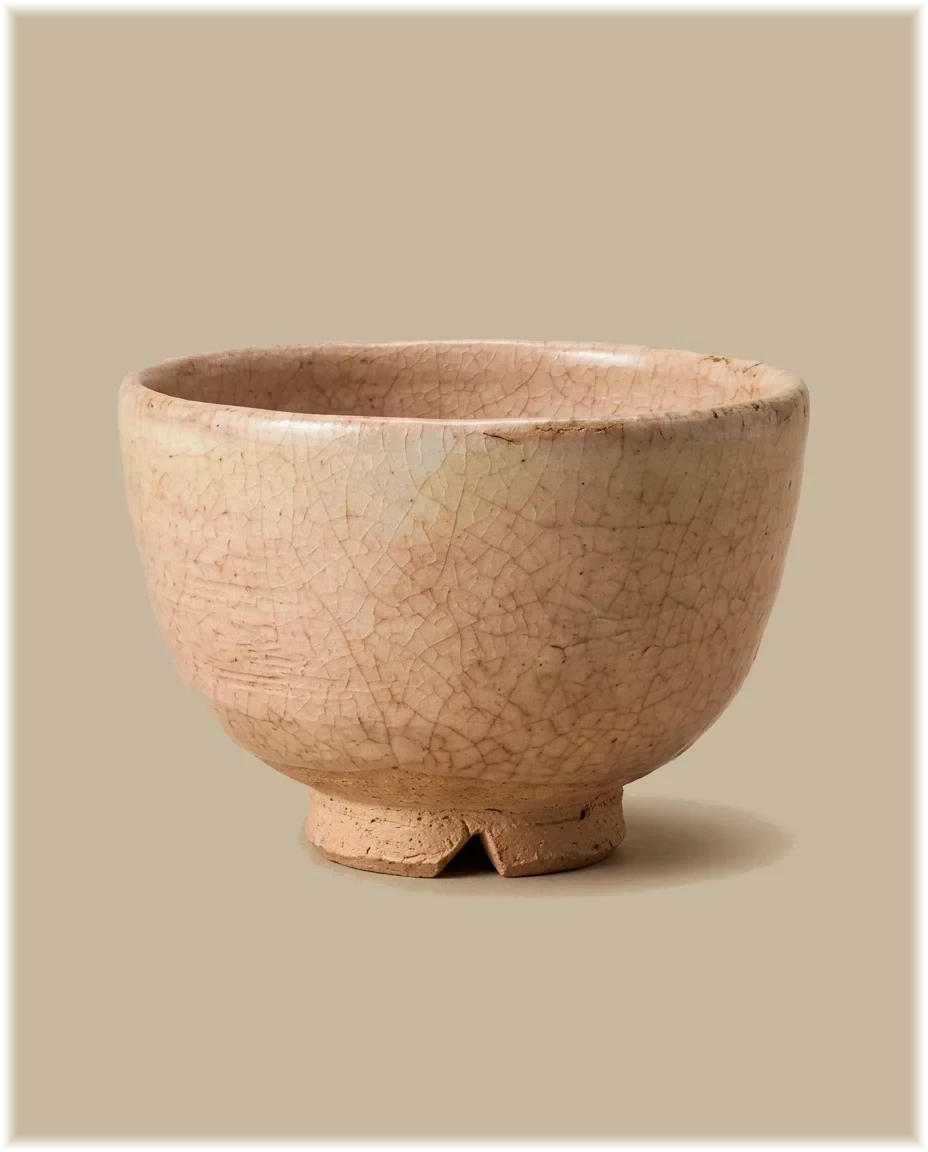
The glazing of a Hagi bowl sets it further apart from the thick, opaque reds and blacks of Kyoto. Hagi potters typically apply a translucent feldspar and wood-ash glaze that fires to milky whites, pale pinks, and warm beiges. Because the bowls are fired in a multi-chambered climbing kiln (登り窯, noborigama) at higher temperatures than Raku, they are physically stronger, yet they remain highly porous. This porosity, combined with the characteristic crackle in the glaze, dictates exactly how a Hagi bowl will behave over a lifetime of daily use.
How does Hagi ware change color over time?

When you examine a brand-new Hagi tea bowl under a good light, the surface is fractured into thousands of microscopic, interlocking lines. This fine network of crazing is known as kan-nyu (貫入). In Western industrial ceramics, a crazed glaze is often treated as a manufacturing defect. In the Hagi tradition, it is an engineered feature and the entire point of the vessel. The crazing forms because the clay body and the glass-like glaze shrink at slightly different rates as the bowl cools inside the kiln.
This crackle is the mechanism behind a phenomenon known as Hagi no nanabake (萩の七化け), or the “seven transformations of Hagi.” Because the clay remains porous and the glaze is riddled with microscopic fissures, the bowl is essentially permeable. When you prepare matcha in a Hagi bowl, the hot water and the microscopic tea tannins seep through the kan-nyu into the soft clay beneath. The bowl absorbs a tiny fraction of the tea every time it is used.
Over years of daily handling, this absorption physically alters the appearance of the object. A bowl that left the kiln as a pale, uniform ivory will gradually develop deep amber, warm brown, and sometimes pale green veins along the crackle lines. The color of the clay itself deepens as tea and the natural oils from human hands work their way into the porous body. It is a slow, irreversible staining process that tea practitioners highly value, as it proves the bowl has been incorporated into a daily routine.
The speed and nature of this transformation depend entirely on the user. A bowl used once a month will remain relatively static, while one used every morning on a desk will change rapidly. Hagi potters advise rinsing a new bowl with warm water before its first use to temper the initial absorption, but they fully expect the vessel to leak slightly in its early days. As the tea tannins build up inside the microscopic fissures, they naturally seal the bowl, stopping the leakage and leaving behind a permanent map of its usage.
The bowl absorbs a tiny fraction of the tea every time it is used.
Why do Bizen and Shigaraki bowls have no glaze?
While Raku and Hagi rely on applied glazes to define their surface, the traditions of Bizen and Shigaraki strip the ceramic process back to its barest elements: earth and extreme heat. Both belong to the “Six Ancient Kilns” of Japan, regions that have produced continuous streams of pottery for over eight hundred years. They specialize in yakishime (焼締め), a method of high-firing unglazed stoneware until the clay itself vitrifies, becoming incredibly dense and watertight without the need for a glass coating.
Bizen ware (備前焼, Bizen-yaki) is produced in Okayama Prefecture from a dense, iron-rich clay harvested from beneath local rice paddies. Because this specific clay has a high shrinkage rate and a low resistance to sudden temperature changes, it must be fired very slowly. Bizen potters load their wood-fired climbing kilns and keep the fire burning continuously for ten to fourteen days, reaching temperatures in excess of 1,200 degrees Celsius. With no glaze applied, the extreme kiln environment acts as the only decorator.
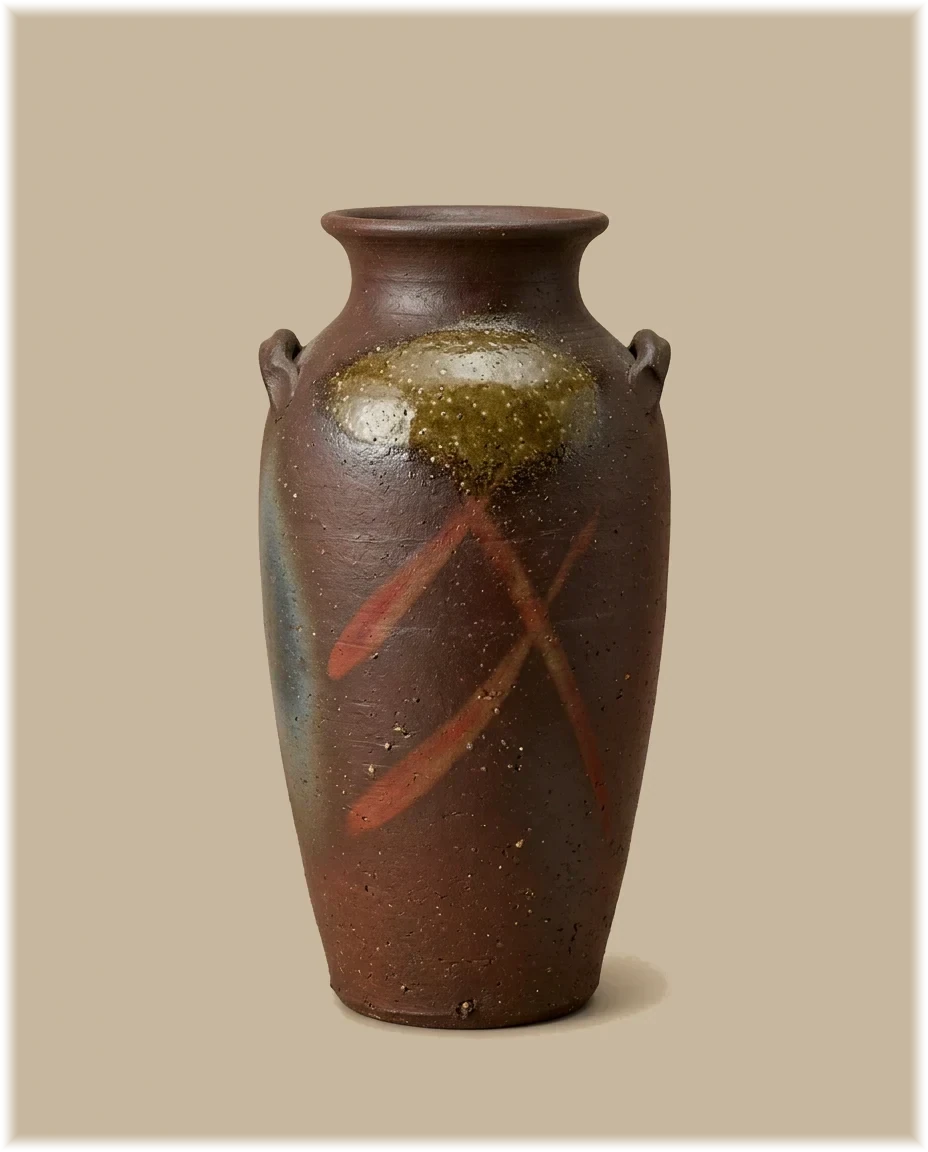
The patterns that appear on a Bizen tea bowl are direct records of where it sat in the fire. Flying pine ash melts against the clay to form tiny, yellow-brown speckles known as goma (胡麻), or sesame seeds. Where pieces are wrapped in rice straw before firing, the straw burns away, leaving vivid red scorch marks called hidasuki (火襷) against the dark, earthy background. The resulting bowl is heavy, hard, and aggressively rustic, looking more like a heavy stone than a delicate cup.
Shigaraki ware (信楽焼, Shigaraki-yaki), from the mountains of Shiga Prefecture, shares this unglazed, wood-fired philosophy but uses a completely different geological material. Shigaraki clay is notoriously coarse. It contains high levels of naturally occurring quartz and feldspar granules. When fired for days in a wood kiln, the iron in the clay oxidizes into a warm, fiery orange-pink known as hi-iro (火色). The feldspar granules burst to the surface, creating a bumpy, starlit texture. In the hottest parts of the kiln, falling ash melts into pools of glassy, olive-green natural glaze known as bidoro (ビードロ). A Shigaraki tea bowl is a study in rough contrasts, built from gritty earth and violent heat.

How does the clay affect the feel of a matcha bowl?
The shape and material of a tea bowl (茶碗, chawan) dictate how it behaves in the hands. Unlike a teacup with a handle, a chawan requires the user to cup the entire vessel in both palms, making the texture, weight, and thermal conductivity of the clay unavoidable. The physical sensation of lifting a bowl to drink from it changes entirely depending on which of these four traditions the potter followed.
A Raku bowl feels unnervingly soft. Because the clay is low-fired, it lacks the sharp, glass-like hardness of porcelain. The carved, uneven walls fit naturally against the palms, and the thick, porous clay acts as a highly effective insulator. You can pour boiling water into a Raku bowl, and the outside will only feel pleasantly warm. However, this same low-fired porosity makes Raku fragile; it chips easily if knocked against a hard surface and must be handled with deliberate care.
Hagi bowls offer a middle ground between the lightness of Raku and the density of unglazed stoneware. They have a comforting, moderate weight. The pale, crackled glaze is smooth against the lips, but the exposed clay at the base is distinctly gritty. Most Hagi bowls feature a wari-kōdai (割高台), a deliberate notch or slice cut out of the circular footring. This notch provides a tactile resting place for the thumb or index finger when lifting the bowl, anchoring the vessel securely in the hand.
The unglazed yakishime bowls are an entirely different tactile experience. A Bizen bowl is heavy. It feels dense and compacted, and if you tap the rim with a fingernail, it produces a high, clear, metallic ring. When brand new, the unglazed surface of a Bizen bowl can feel slightly harsh against the skin. However, over years of being held, washed, and dried with cotton cloths, the friction naturally burnishes the iron-rich clay. The microscopic rough edges wear down, and the bowl develops a smooth, subtle luster.
Shigaraki bowls are the most aggressively textured of the four. Running a thumb over a Shigaraki bowl means navigating the embedded nodules of exploded feldspar and the slick, glassy pools of natural ash glaze. The rim can be coarse against the lips, demanding that the user pay attention to the physical act of drinking. Where Raku seeks to comfort the hands and Hagi slowly records the passage of time, Shigaraki and Bizen bring the raw, unpolished reality of the Japanese landscape directly to a modern desk.
Which Japanese tea bowl is right for a first purchase?
For a collector or a daily tea drinker, the choice of kiln dictates not just how the bowl looks, but how it must be maintained and how it will age. The geographical origin of the clay fundamentally alters its chemical makeup, which in turn determines how it will react to the extreme heat of the kiln.
| Tradition | Origin | Formation | Firing Method | Surface | Aging Characteristics |
|---|---|---|---|---|---|
| Raku | Kyoto | Hand-carved | Low-fired, indoor kiln | Thick black or red glaze | Remains visually static; highly fragile. |
| Hagi | Yamaguchi | Wheel-thrown | Medium-fired, climbing kiln | Pale crackled glaze | Rapidly absorbs tea, darkening over years. |
| Bizen | Okayama | Wheel-thrown | High-fired, 10-14 days | Unglazed, natural fire marks | Slowly burnishes and smooths with friction. |
| Shigaraki | Shiga | Wheel-thrown | High-fired, wood kiln | Rough feldspar, natural ash | Softens slightly; highly durable and gritty. |
Choosing between these traditions is not a matter of identifying the objectively superior bowl. The historical ranking of “Ichi-Raku, Ni-Hagi” reflects the specific aesthetic preferences of sixteenth-century Kyoto tea masters, not an absolute measure of quality. A heavy, unglazed Bizen bowl requires no less skill to fire than a hand-carved black Raku piece. The distinction lies entirely in what the user wants to hold in their hands on a Tuesday afternoon.
Ultimately, a tea bowl is not a static sculpture, nor is it meant to be kept pristine behind glass. It is a functional tool engineered to hold heat, protect the hands, and withstand the friction of a bamboo whisk. The real value of learning to distinguish the soft porosity of Hagi from the dense grit of Shigaraki is that it allows the user to find an object that matches the rhythm of their own routine. A bowl only fulfills its purpose when filled with hot water, lifted, and eventually worn down by the quiet attrition of daily life.
Maison Homura is a small museum of Japanese objects in Fukuoka — folk toys, ceramics, carved wood and Takaoka bronze, each catalogued with where it was made, how, and what it was for.